
9 Famous Paintings with Cats—and the Stories Behind Them
See nine paintings with cats by Renoir, Bonnard, Louis Wain, Manet, Goya and more, with original images, memorable details and collection links.
Table of Contents
- The paintings at a glance
- 1. Julie Manet (Child with Cat) — Auguste Renoir
- 2. The White Cat — Pierre Bonnard
- 3. The Bachelor Party — Louis Wain
- 4. The White Cat — Franz Marc
- 5. Olympia — Édouard Manet
- 6. Manuel Osorio Manrique de Zuñiga — Francisco Goya
- 7. Woman with a Cat — Auguste Renoir
- 8. Two Children Teasing a Cat — Annibale Carracci
- 9. Still Life with Cat — Paul Gauguin
- Looking for famous paintings with cats added?
- A few common questions about cats in art
- Which artist is famous for painting cats?
- What is the famous black cat picture?
- Where can I see the original paintings more closely?
Some of the most memorable paintings with cats are Renoir's Julie Manet, Bonnard's The White Cat, Louis Wain's The Bachelor Party, and Manet's Olympia. In some, the cat takes over the picture. In others, a small pair of eyes or an upright tail changes the whole scene.
Here are nine works to explore, from a kitten contentedly sitting in a child's lap to five cats enjoying a very human evening. Every cat below belongs to the historical painting itself. If you came looking for cats added to the Mona Lisa or other masterpieces, there is a short guide to those modern reimaginings after the paintings.
The paintings at a glance
| Painting | Artist | Date | Look for |
|---|---|---|---|
| Julie Manet (Child with Cat) | Auguste Renoir | 1887 | The kitten nestled in Julie's lap |
| The White Cat | Pierre Bonnard | 1894 | The astonishingly long legs and arched back |
| The Bachelor Party | Louis Wain | Undated | Five cats gathered around a table |
| The White Cat | Franz Marc | 1912 | A curled cat on a yellow cushion |
| Olympia | Édouard Manet | 1863 | The black cat at the foot of the bed |
| Manuel Osorio Manrique de Zuñiga | Francisco Goya | 1787–88 | Three cats watching a magpie |
| Woman with a Cat | Auguste Renoir | c. 1875 | A tabby held close to the sitter |
| Two Children Teasing a Cat | Annibale Carracci | Not specified | A tense encounter at a tabletop |
| Still Life with Cat | Paul Gauguin | c. 1899 | A small cat beneath an enormous bouquet |
This selection brings together celebrated cat pictures and cat-filled works by major painters. It is a viewing guide, rather than a ranking of the world's “most famous” painting.
1. Julie Manet (Child with Cat) — Auguste Renoir
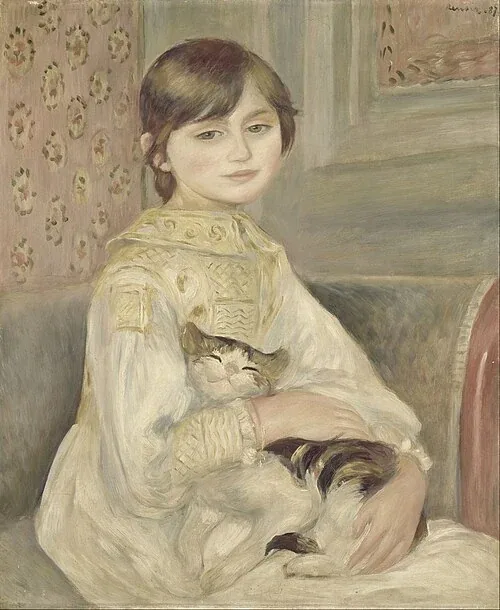
1887 · Oil on canvas · Musée d'Orsay, Paris. Public-domain reproduction via Google Art Project / Wikimedia Commons.
Start with the kitten's face. Its narrowed eyes and relaxed position give it a wonderfully satisfied expression, while Julie holds it securely against her pale dress. The dark stripes on the cat's forehead make a small, lively contrast with the soft colors around it.
Julie was the daughter of painter Berthe Morisot and Eugène Manet, Édouard Manet's brother. Her parents commissioned their friend Renoir to paint her in 1887. The Musée d'Orsay's account describes the painting's unusually smooth, carefully finished surface.
Although this is a portrait of Julie, the kitten makes the scene feel less formal. A child sitting for a painter is also simply a child holding a cat. For a gentle, affectionate example of cats in art, this is a lovely place to begin.
2. The White Cat — Pierre Bonnard
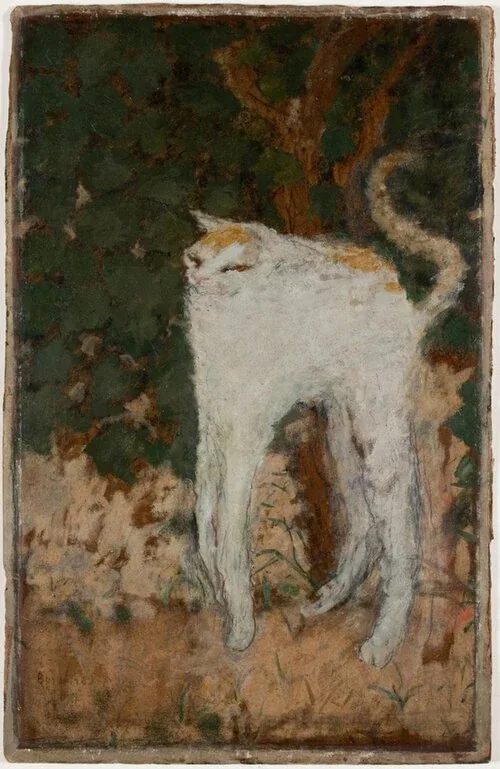
1894 · Oil on board · Musée d'Orsay, Paris. Public-domain image and work record, Wikimedia Commons.
Bonnard's cat looks as though it has stretched upward and forgotten to come back down. Its long legs, lifted back and curling tail turn a familiar feline movement into an improbable silhouette.
The white body stands out against dark green foliage, but the fur is far from a flat white shape: short, rough marks give it a bristly texture. Look at the small head beside those towering legs. That mismatch is a large part of the painting's humor.
This is the cat to remember if you like art that captures an animal's character without drawing every proportion realistically. Its French title is Le Chat blanc. It is a different work from Franz Marc's painting of the same English name, shown below.
3. The Bachelor Party — Louis Wain
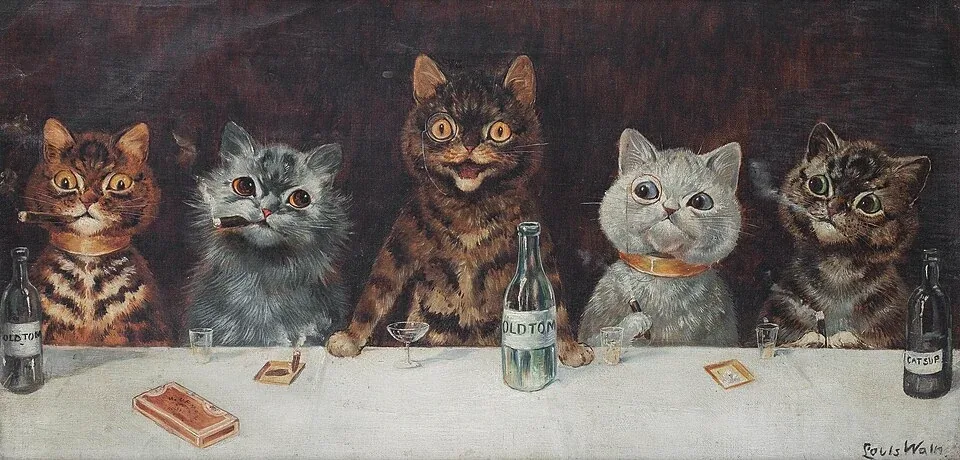
Oil on canvas · Undated in the Bonhams lot record, which cites The Penny Illustrated, Christmas Edition, 1896. Image source: Wikimedia Commons, after Bonhams.
Five cats line up behind a table as if someone has interrupted their night out. Their enormous eyes, upright bodies and different expressions turn the group into a cast of characters. The bottles and glasses make the joke clear: this is a human social occasion performed by cats.
Try looking at each face separately. The pale cat near the right has a very different presence from the tall tabby in the center. Wain gives the group personality through expression and arrangement, rather than through a complicated setting.
If your idea of a famous cat painting involves cats behaving like people, Wain is an essential artist to explore. This particular picture also rewards a wider view: the full row of five cats is the point, so a tight crop loses much of the comedy.
4. The White Cat — Franz Marc
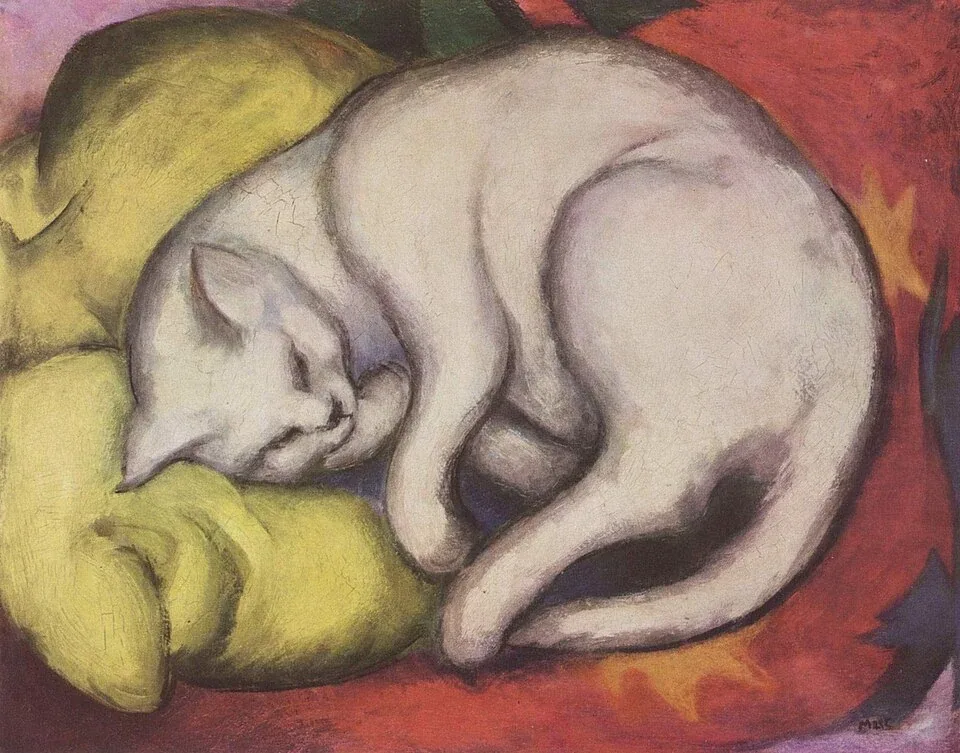
1912 · Painting · Kunstmuseum Moritzburg Halle (Saale). Public-domain reproduction: The Yorck Project / Wikimedia Commons.
Where Bonnard's white cat stretches upward, Marc's curls inward. The rounded back, tucked head and dark tail fit together almost like pieces of a puzzle. Yellow beneath the cat and red around it make the resting body feel warm and sheltered.
The museum's collection account identifies The White Cat as a 1912 work in its holdings. Its appeal is easy to see without knowing anything about Expressionism: it captures the compact shape of a cat that has found exactly the right place to sleep.
Compare it with Bonnard's painting above. Both use a white cat as the main subject, yet one feels springy and exaggerated, while the other feels settled and quiet. The shared title makes them easy to confuse; their silhouettes make them easy to tell apart.
5. Olympia — Édouard Manet
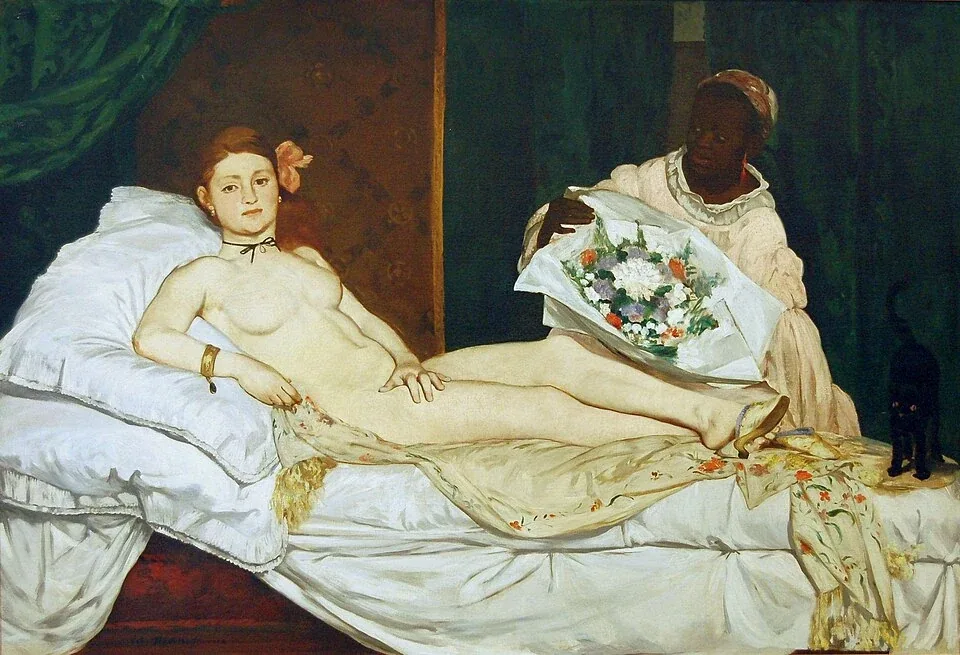
1863 · Oil on canvas · Musée d'Orsay, Paris. Public-domain reproduction via Wikimedia Commons; file credits Gautier Poupeau.
The black cat is easy to miss at first. Look at the far right, beside the reclining woman's feet: its upright tail and small bright eyes emerge from the dark background.
Olympia caused a scandal when it appeared at the Salon of 1865. The Musée d'Orsay's description on Google Arts & Culture explains how Manet challenged the idealized female nude with an unmistakably contemporary subject.
The cat adds a restless note to an otherwise still pose. Compare its alert silhouette with the reclining figure, then follow how that dark shape interrupts the pale bed. Unlike Wain's party guests, this cat barely occupies any space. It shows how a small animal can become a memorable detail in a much larger, famous composition.
6. Manuel Osorio Manrique de Zuñiga — Francisco Goya
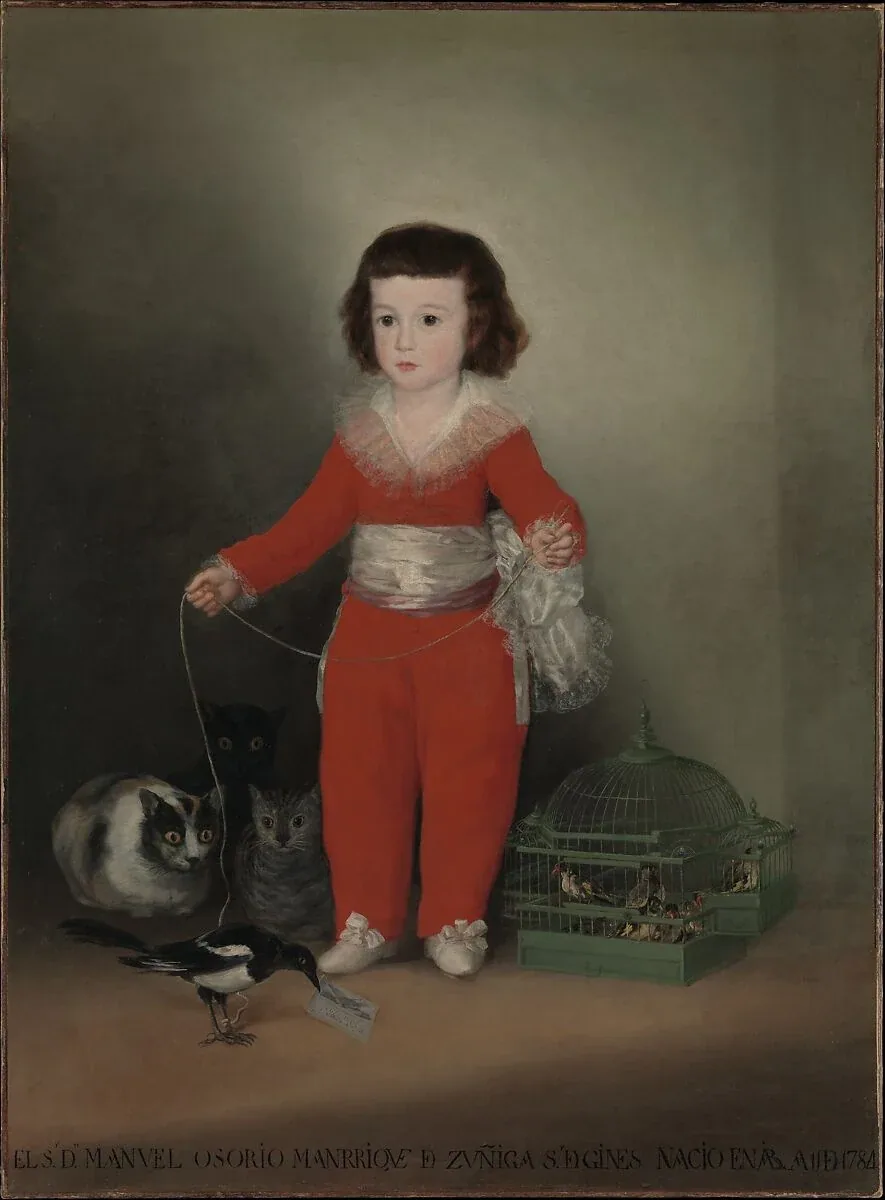
1787–88 · Oil on canvas · The Metropolitan Museum of Art, The Jules Bache Collection, 1949; 49.7.41. Public-domain image, The Met.
The boy's red outfit draws the eye, but the cats supply the suspense. There are three of them to the viewer's left, all interested in the magpie in front of the child. Look closely: one cat is much harder to distinguish in the shadows than the others.
The bird holds Goya's calling card in its beak. According to The Met's record, the animals may suggest threats around the child's world or the fragility of innocence. That is a possible interpretation; the immediate visual story is simpler. The boy seems composed, while the cats look ready for something to happen.
This is an especially good painting for a “find the cats” moment. First find the obvious faces, then search the darkness for the third. The dates 1784–1792 in the museum's full title are the boy's lifespan, not the painting's date.
7. Woman with a Cat — Auguste Renoir
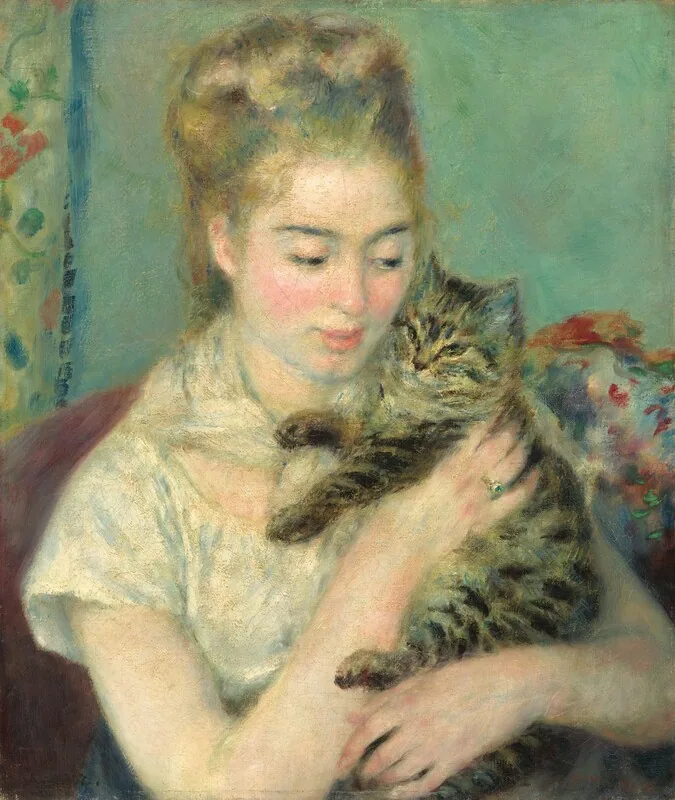
c. 1875 · Oil on canvas · National Gallery of Art, Gift of Mr. and Mrs. Benjamin E. Levy; 1950.12.1. Public-domain image, NGA.
Renoir returns here with a different kind of embrace. The woman's arms surround a substantial striped tabby, drawing its face close to hers. Her downward gaze connects the two figures, while the cat looks outward.
Compared with the kitten in Julie Manet, this cat appears more alert and less ready to sink into someone's lap. Its strong stripes and pointed ears stand out against the softly painted face and clothing. You might read its expression as serious or slightly put-upon; that contrast is part of the fun of looking.
The National Gallery of Art dates this work to about 1875. Set it beside the 1887 Julie portrait and you have two very different answers to the same subject: what happens when a person tries to sit quietly with a cat?
8. Two Children Teasing a Cat — Annibale Carracci
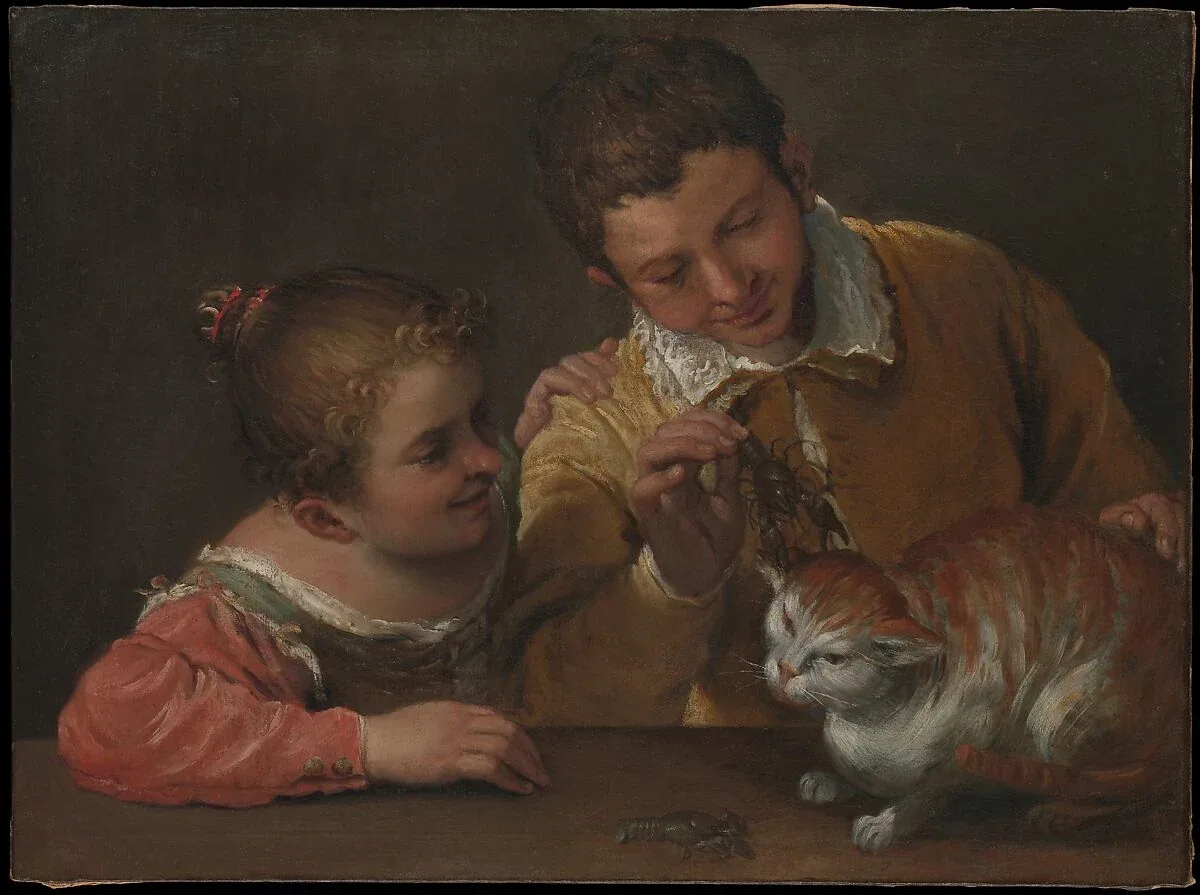
Oil on canvas · The Metropolitan Museum of Art; 1994.142. Purchase, Gwynne Andrews Fund, and Bequests of Collis P. Huntington and Ogden Mills, by exchange, 1994. Public-domain image, The Met.
This is a much less comfortable encounter. Two children torment a cat with a crayfish, and the scene seems poised just before the animal lashes out. The closeness of the hands, claw and cat's face makes the action easy to follow.
The Met describes it as an early Italian genre painting—a picture of everyday life—and suggests that it may illustrate a proverb comparable to letting sleeping dogs lie.
The fascination comes from the suspended moment: the children find the situation amusing, but the cat plainly does not. Alongside Renoir's affectionate portraits, it demonstrates how differently artists have pictured relationships between people and animals. The exact year is not specified in the museum overview linked here.
9. Still Life with Cat — Paul Gauguin
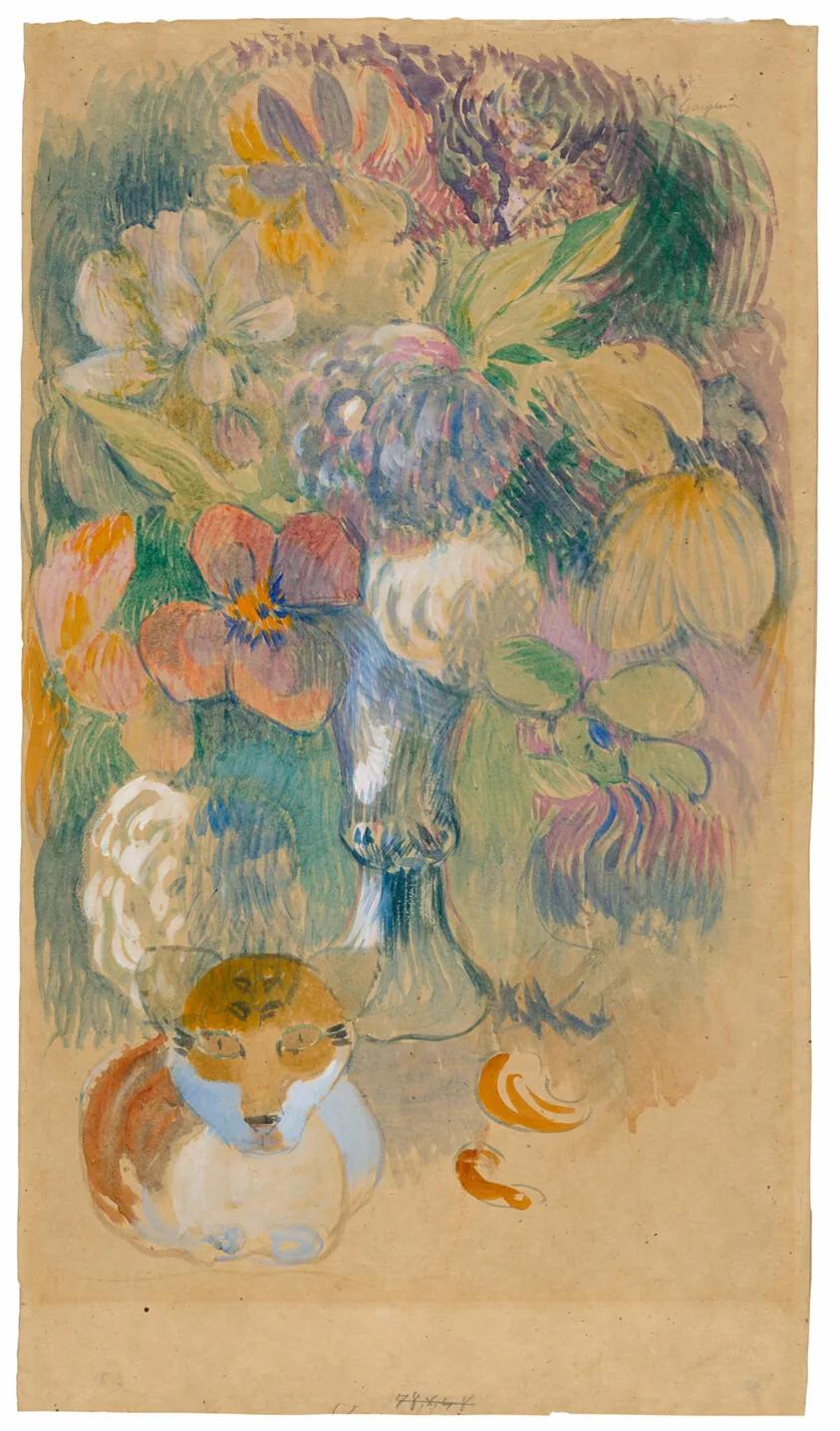
c. 1899 · Watercolor on paper · Art Institute of Chicago, Gift of Helen Tieken Geraghty in memory of Dr. and Mrs. Theodore Tieken; 1981.409. Image: CC0 Public Domain Designation.
A towering bouquet fills most of this picture. The cat sits below it at the lower left, small enough that you may notice the flowers first.
Once you find the animal, the composition becomes more playful. Its compact head and body counter the crowded stems and blossoms above. The orange in its coat also echoes warm patches elsewhere in the image, so the cat belongs to the color arrangement as well as to the scene.
The Art Institute of Chicago identifies this as a watercolor, despite its dense, layered appearance. It is a quieter discovery than the all-cat pictures above, and a reminder that a painting does not need to be a pet portrait to give a cat an important role.
Looking for famous paintings with cats added?
Cat versions of the Mona Lisa, The Starry Night and other familiar compositions belong to a different tradition: modern artists reimagining earlier works.
A well-known example is Fat Cat Art, credited by its creator to Svetlana Petrova and Zarathustra the Cat. Its humor comes from inserting a conspicuous cat into a composition viewers already recognize. The cats in those reinterpretations should not be attributed to the original historical painters.
If you want to explore that idea with your own cat, Frameow has Mona Lisa, Starry Night, and Girl with a Pearl Earring styles. These create modern AI-generated digital portraits from your cat's photo.
A few common questions about cats in art
Which artist is famous for painting cats?
Louis Wain is a strong starting point, especially for cats behaving like people. The Bachelor Party above shows his comic side. For a different mood, compare Bonnard's stretched silhouette, Marc's sleeping cat and Renoir's affectionate portraits. Each gives the animal a distinct personality through pose, color or expression.
What is the famous black cat picture?
If you mean the black cat on a yellow poster, you are probably thinking of Théophile Steinlen's La tournée du Chat Noir. It appears in Google Arts & Culture's cat-art guide. It is a poster, which is why it is separate from the paintings in this list. If you remember a black cat beside a bed, look at Manet's Olympia above.
Where can I see the original paintings more closely?
Follow the collection links beside each work for larger images and object details. A collection's ownership does not necessarily mean a painting is currently on display, so check its current visiting information before planning a trip. For online browsing, compare the full image before zooming in: a cat's place in the scene often tells you as much as its face.
Cat portrait tutorials, creative gift ideas, and new styles from the Frameow team.