
Cat Character Design: Turn a Real Habit Into a Character
Design an original cat character using recognizable markings, one clear goal and a useful prop. Includes a printable character worksheet.
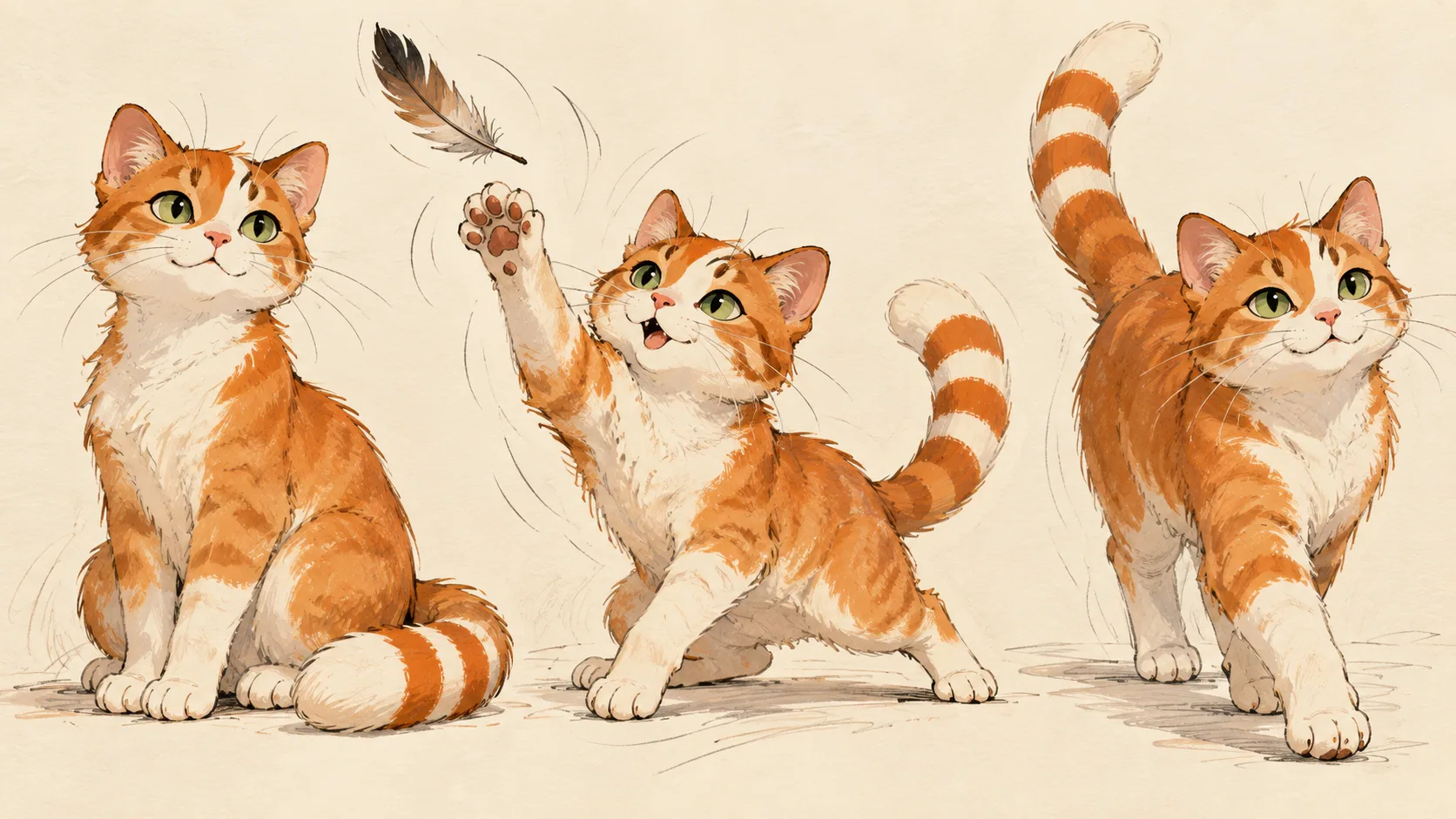
Table of Contents
Start a cat character with a habit you can draw: checking every bag, sleeping on a notebook or watching the same window. That action suggests a personality more clearly than a list of adjectives.
Download the character worksheet. Use it for an original fictional cat or an authorized reference photo. The exercise is character planning, not a claim that Frameow generates pose sheets or accepts arbitrary story prompts.
Keep three identity anchors
Choose a body shape, an ear shape and one marking. For example: a compact body, one slightly rounded ear and a pale patch under the chin. Draw them in front, side and back views before adding costume details.
These anchors prevent a character from becoming a different cat every time the pose changes. Put the markings on a small reference sheet; memory alone is unreliable when you flip the direction of the head.
Give the cat a task that creates a pose
“Curious” is hard to draw. “Trying to see inside a paper bag without putting a paw in” supplies a head angle, a weight shift and an expression.
Try three original premises:
- The window astronomer: waits for one bright point each evening; a notebook records observations, while the tail points toward the view.
- The lost-button keeper: carries a tiny box of found objects; checking the lid creates a recognizable repeated action.
- The reluctant rain scout: wants to inspect the garden but tests the doorway with one paw first; the hesitation supplies the pose.
These are starting ideas, not finished character sheets. Change the actions and props to fit the cat you are drawing.
Make fantasy details earn their place
A cape, wand or crown should help explain what the character does. A navigator might carry a map; a keeper of memories might guard a small album. If removing a prop changes nothing about the story, consider leaving it out.
Choose one dominant silhouette change. Large horns, wings, a hat and a tall collar together can obscure the ear and head shapes that made the character recognizable.
Test three expressions
Draw attention, uncertainty and satisfaction using the same head shape. Change the brow, eyelid and mouth positions while preserving the eye spacing and muzzle width. Then remove the face details temporarily: does the body still help communicate the emotion?
For a final check, show the front and side sketches beside the reference. Identify what stayed constant and what you deliberately exaggerated. Keep the distinction explicit: this is an interpretation of a cat, not a literal likeness study.
Sketch the fantasy scene before refining the costume
Draw three small scene boxes: where the cat begins, what interrupts the routine and what the cat does next. For the window astronomer, that could be an empty sky, a cloud covering the chosen star and the cat moving to another window. The sequence supplies a reason for a pose change.
Keep the same ear shape and marking in all three boxes. Add only the props the action uses. A complete fantasy character needs to work in a scene, not only as a front-facing costume portrait; these thumbnails are a planning exercise, not a claim of a finished illustrated story.
Cat portrait tutorials, creative gift ideas, and new styles from the Frameow team.