
Plan a Multiple-Cat Portrait From Separate Photos
Prepare a group cat portrait with individual references, relative-size notes and a composition brief. Check identity and capability before ordering.
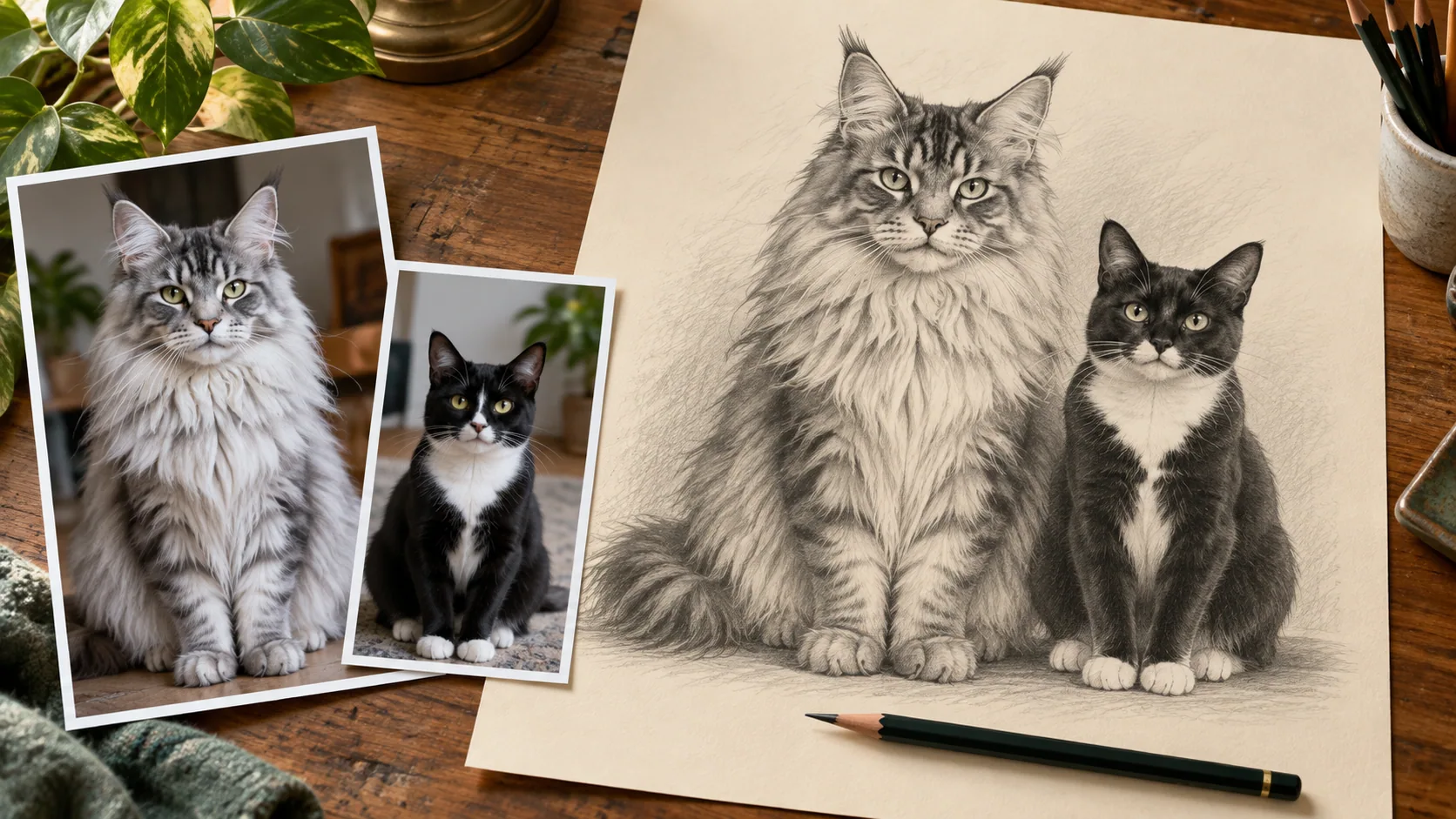
Table of Contents
Separate photographs can be useful references for a group portrait, but they do not automatically belong in the same scene. Camera height, body scale and light direction can make two familiar cats look unrelated when placed together.
Download the multi-cat brief. It helps you give an artist distinct references and a clear composition request. It is not a claim that every portrait service supports combining cats, and this article does not promise a multi-photo Frameow feature.
Give each cat an identity sheet
Choose one main photograph per cat and label the files clearly. Add a second image only when it supplies missing information, such as a chest marking or tail shape. Avoid mixing photographs of different ages without telling the artist which appearance you want.
Write a short identity note: “A has a white chin; B has a dark chin,” for example. In a pair of similar-looking cats, these distinctions matter more than a large collection of poorly labeled images.
Explain relative size
Two close-up faces may occupy the same number of pixels even when one cat is much larger. Provide a photograph of them together if you have one, or explain their approximate relative size in words.
Do not infer body proportions from a wide-angle close-up. A cat nearer the camera may look larger for that reason alone. Ask the artist to establish the intended scale in a composition proof.
Choose an arrangement that fits the references
Side by side suits similarly angled references and gives each cat equal emphasis. Staggered depth can use different body poses, but the overlap must keep each face clear. Separate panels preserve incompatible angles honestly and can still form a pair through shared colors or framing.
A hypothetical example: if A is photographed at eye level and B from directly above, a matching pair of individual portraits may be more convincing than pretending both occupied the same floor-level scene. That is a planning example, not a documented customer result.
Ask for the right kind of proof
Artist Jess Ridley describes preparing group mock-ups before painting. Ask your chosen maker whether their process includes an equivalent composition review and what changes remain possible afterward.
Check the proof for the correct number of cats, separate bodies and paws, accurate identifying markings, believable scale and intentional overlap. Review light direction and background as a second pass. Approving an attractive overall picture is not the same as checking that every cat is correctly represented.
Before ordering from any service, confirm that it supports your number of subjects and reference format. A gallery of single-cat examples does not establish multi-cat capability.
Cat portrait tutorials, creative gift ideas, and new styles from the Frameow team.