
Build a Small Voxel Cat: Coordinates and Downloadable Mesh
Build an original cat from unit cubes. Download coordinate data and an OBJ mesh, inspect the proportions, and adapt the ears, paws and tail.
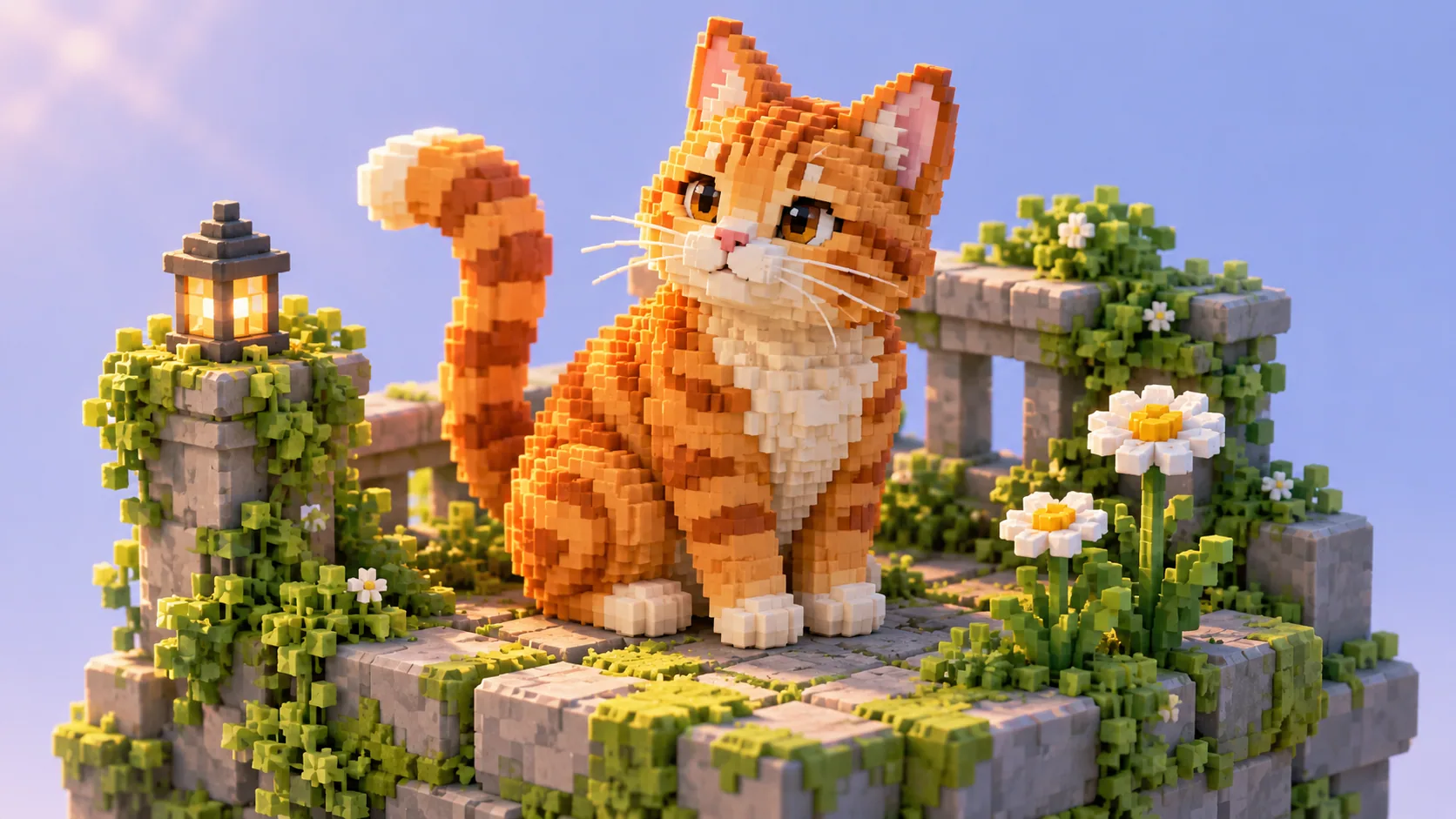
Table of Contents
A small voxel cat needs only a few readable masses: a body, a larger head, two ears, feet and a tail. Build those before adding stripes. If the silhouette does not read as a cat, surface detail will not fix it.
This original study provides a coordinate file and a mesh. It is an editable construction example, not an official game asset, rigged character or guaranteed import for a particular platform.
Download the study
- Voxel coordinates and palette, JSON
- Mesh, OBJ
- Material definitions, MTL
- Front and side planning sheet, SVG
Keep the OBJ and MTL together without changing their filenames. The OBJ refers to voxel-cat.mtl. The JSON is a documented coordinate list, not a native .vox project; use it to rebuild or write an importer rather than assuming any voxel application will open it directly.
Read the coordinate system
Each JSON entry identifies a unit cube by x, y and z, plus a material name. Z is up; negative Y is the front. The lower corner of a cube is its listed coordinate. A cube at x=2 occupies the interval from 2 to 3 along that axis.
Build the main body from x=2 through 7, y=0 through 3 and z=0 through 5. Add the broader head from x=1 through 8, y=-1 through 4 and z=6 through 10. These inclusive ranges translate the file's unit-cube positions into a reproducible starting form.
Add the features in order
Put one ear at each upper corner of the head, then add feet that project forward. Keep a gap between the ears: filling it makes the top look like a rectangular box. The sample's tail rises behind the right side. Rotate the model to check that it connects to the body rather than floating beside it.
Place the eyes on the front, not the side. The sample uses separate dark cubes and a small nose. To give the cat a white muzzle or a striped forehead, change material assignments on existing cubes before increasing model complexity.
Adapt it without losing the structure
Try one change at a time: shorter ears, a wider face or a curled tail. Compare front and side views after each change. An appealing front view can still hide a disconnected feature or a tail intersecting the head.
The supplied OBJ keeps cubes separate and includes interior faces. That makes the structure explicit but creates a heavier mesh than an optimized visible-surface export. It has no UV map, animation rig or collision setup. A production game workflow needs its own optimization and import checks; the file is a modeling exercise.
Cat portrait tutorials, creative gift ideas, and new styles from the Frameow team.